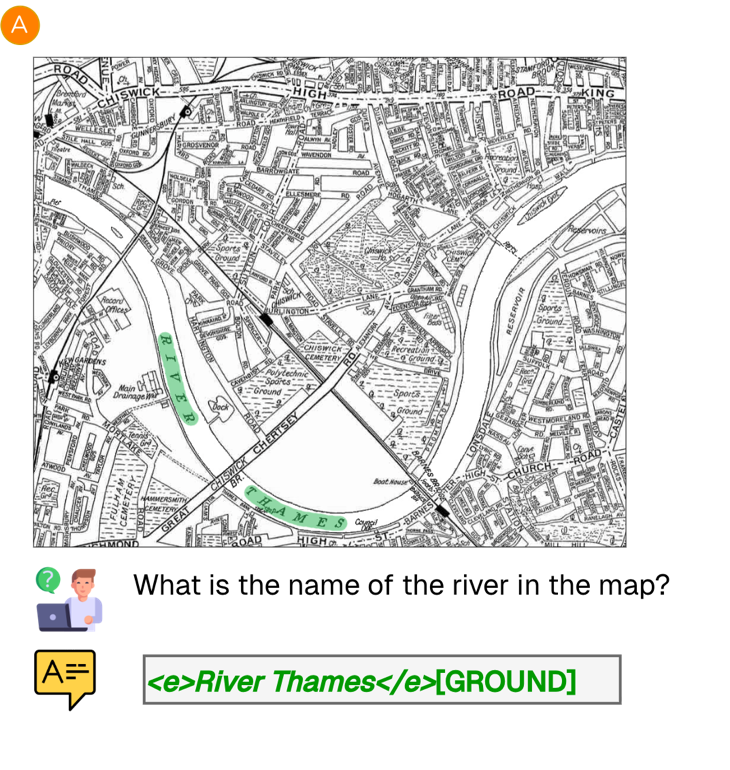
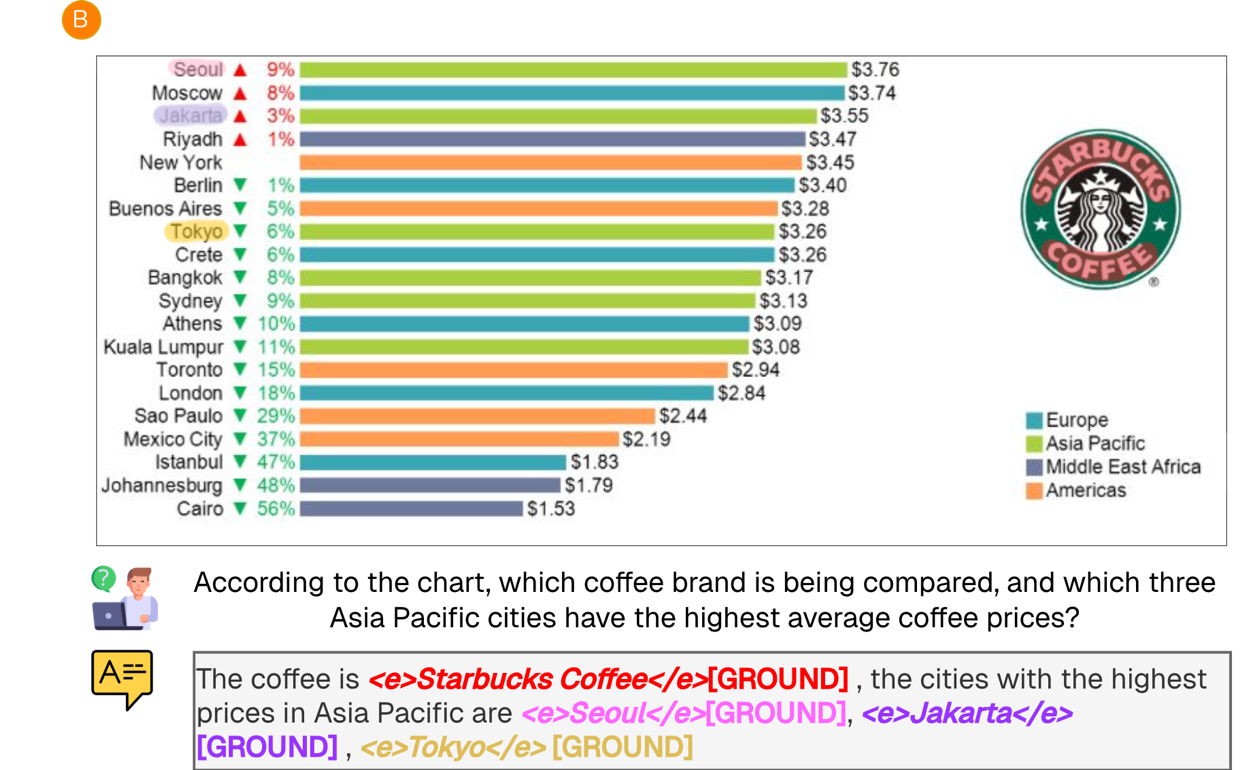
(A) one span: <e>River Thames</e>[GROUND] → the curved river itself — no box could do this.(B) multi-span: the logo and three city rows each get their own mask, in one answer.
M3Grounder · In one picture
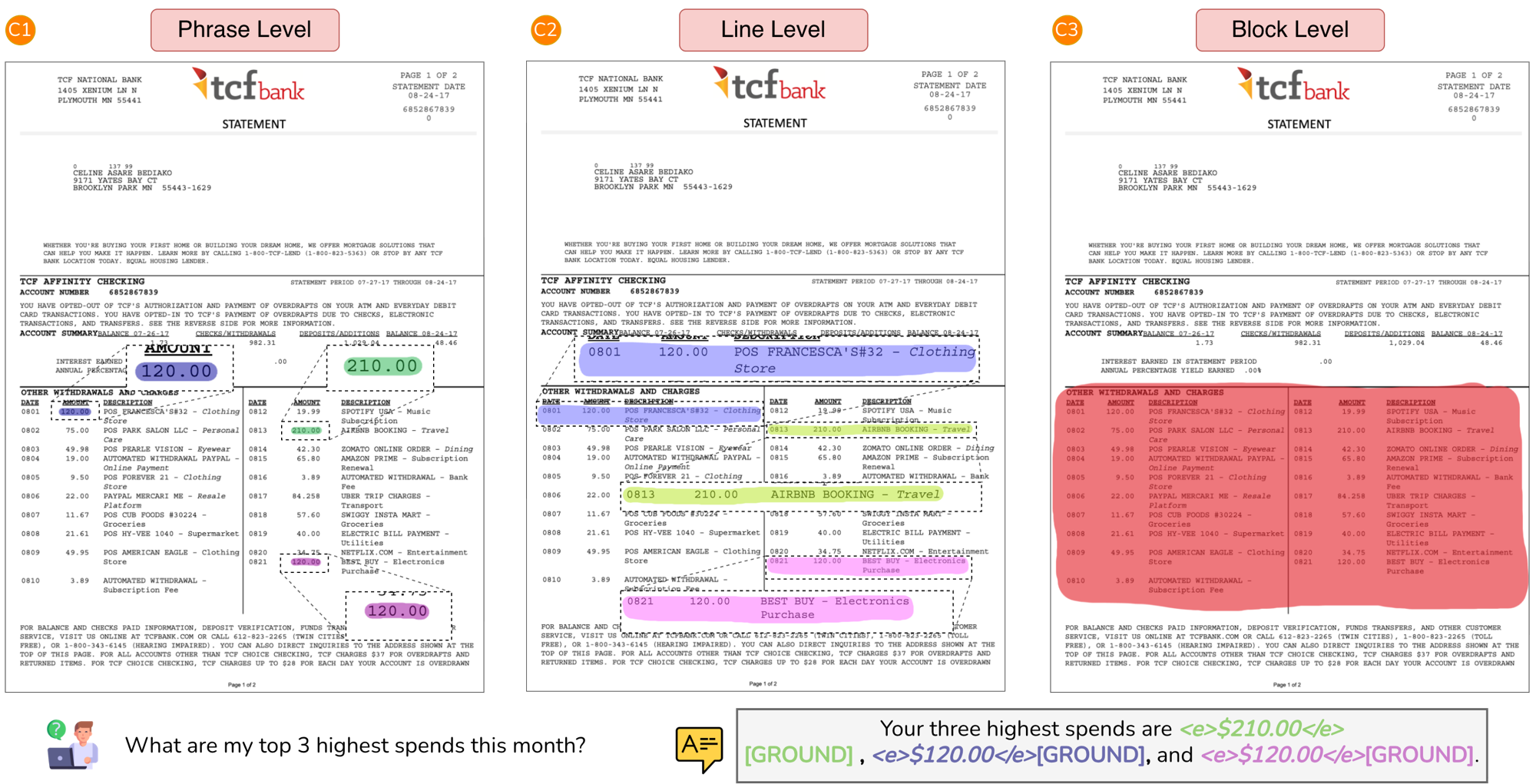
…and the same evidence at three granularities
(C1)–(C3) phrase ⊂ line ⊂ block on a bank statement — cite the number, redact the transaction row, or chunk the whole table. Same [GROUND] token, three nested masks.
M3Grounder · Task
What the model actually outputs
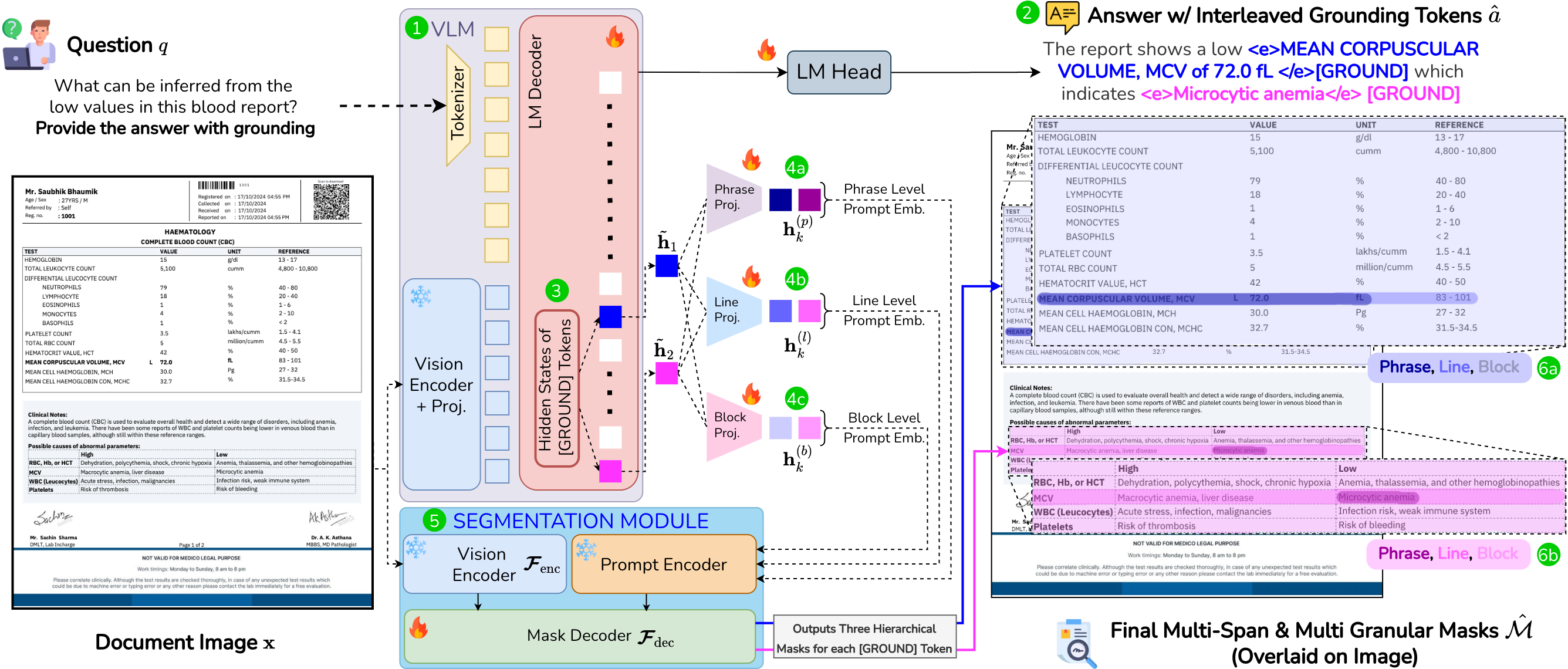
Q: “Which value is abnormal, and what does it indicate?”
A: "The report shows a low <e>MCV of 72.0 fL</e>[GROUND] which indicates <e>Microcytic anemia</e>[GROUND]"
fθ(x, q) → (â, {M̂k(i)}k=1…K) each [GROUND] k → three nested masks, i ∈ {p, l, b}
Multi-span
K is free — one answer, many disjoint regions. K = 0 → M̂ = ∅, a plain answer.
Multi-granular
Different uses need different scopes: cite a number, redact a row, chunk a section.
M3Grounder · Architecture
VLM + three MLP heads + promptable segmenter
① VLM encodes page + question · ② answer with interleaved [GROUND] · ③ hidden states h̃k · ④ 3 granularity MLP heads ⑤ dense features z, encoded once · ⑥ mask decoder → hierarchical masks
Backbones: InternVL3.5-8B (-I) / Qwen3-VL-8B (-Q) · segmenter: SAM, backbone-agnostic · grounding adds +63 ms per sample (508 vs 445 ms, 1×H100)
M3Grounder · Interactive
The forward pass, animated — a lab report walks through the model
Click inside to drive it · Space pause · R restart · F fit — then use ‹ › to continue the talkopen standalone ↗
M3Grounder · Training objective
One objective, four losses
λlm𝓛lm
+
λseg𝓛seg
+
λbleed𝓛bleed
+
λhier𝓛hier
𝓛lm
next-token cross-entropy — the answer text itself
𝓛seg
Dice + BCE on every mask, at each granularity
𝓛bleedNOVEL
stay on the text — no spilling into graphics
𝓛hierNOVEL
the three masks must nest: p ⊂ l ⊂ b
The two novel losses encode document priors the generic segmentation losses don't know about — next two slides.
M3Grounder · Novel loss ①
𝓛bleed — don't spill off the text
𝓛bleed =
mask mass off the text
whole mask
= Σ M̂ ⊙ (1 − Mtext) / (Σ M̂ + ε) · Mtext = union of all text pixels
A fraction — a small mask is policed as strictly as a large one.
M3Grounder · Novel loss ②
𝓛hier — make the masks nest
𝓛hier =
finer mask outside the coarser
finer mask
the coarser mask is the ground truth of the next level up · applied to (phrase→line) and (line→block)
74.0 → 78.2
GDQA F1g, phrase — from adding 𝓛hier alone
Charts are single-level — no line/block, so no 𝓛hier there.
M3Grounder · Data engine · pipeline ①
GroundingDocQA: 200K docs · 2M QA — no hand-drawn masks
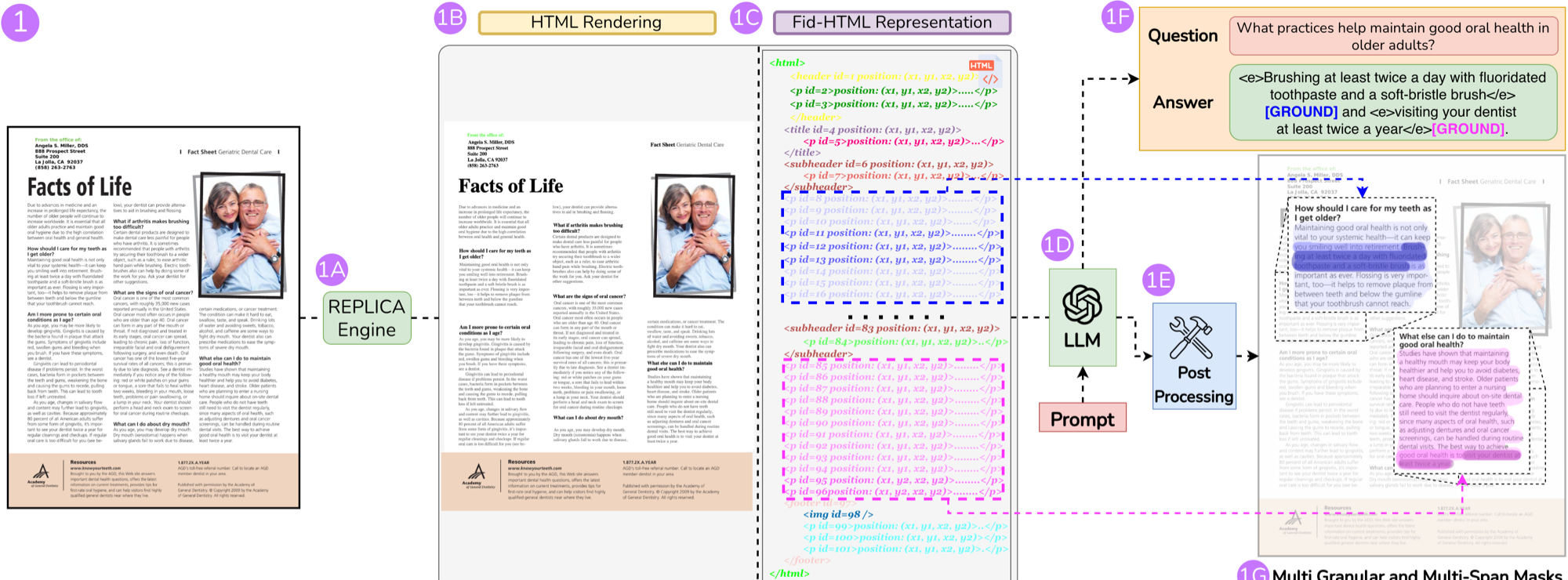
① 140K layout-aware documents
REPLICA rebuilds each page as ID-tagged "Fid-HTML" (1A–1C) → an LLM writes QA citing element IDs, never coordinates (1D) → post-processing maps IDs back to boxes, Hi-SAM turns them into masks (1E) → grounded QA pairs (1F–1G). Hallucinated geometry is impossible by construction.
M3Grounder · Data engine · pipeline ②
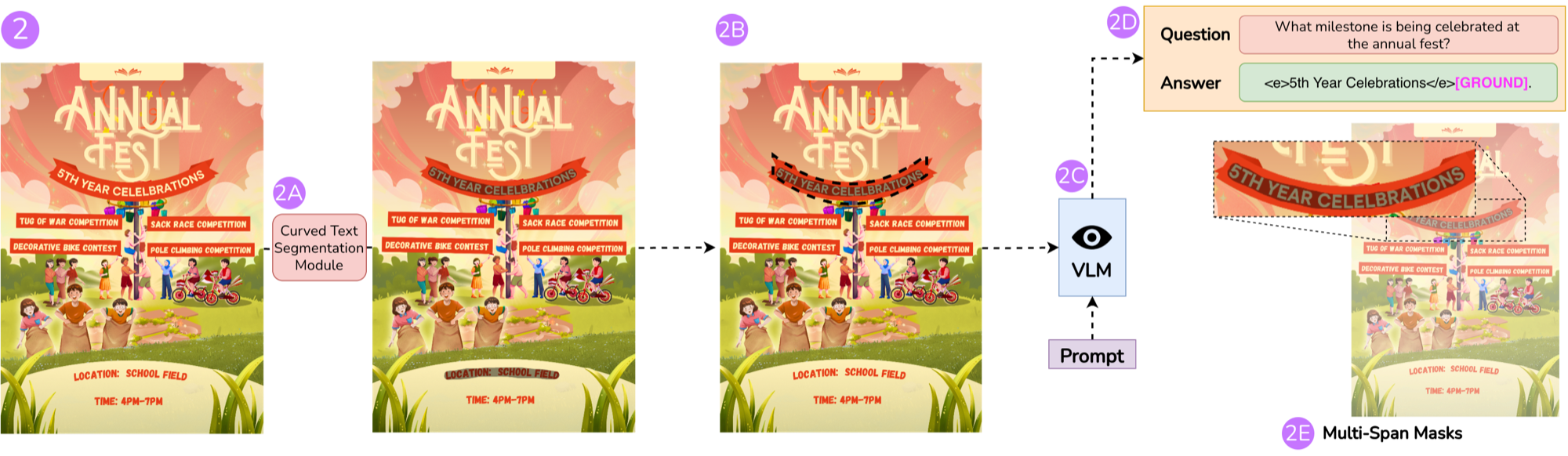
Curved text: highlight, then ask
② 10K curved-text documents
curvature detection (2A) → the curved mask is overlaid on the page as a Set-of-Mark highlight (2B) → a VLM (2C) writes QA strictly about the highlighted region — the mask exists before the question does, so grounding is exact by construction.
M3Grounder · Data engine · pipeline ③
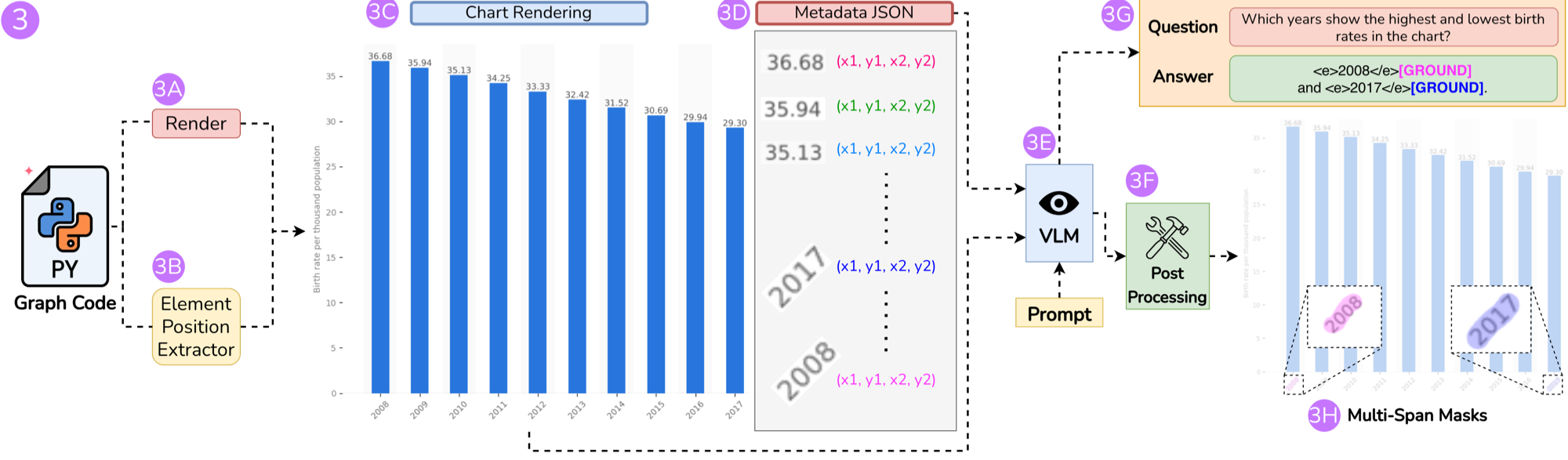
Charts: intercept the renderer
③ 50K charts
Renderer interception: execute the plot script (3A), record every element's true position at render time — axes, ticks, bars, legends (3B–3D) → a VLM writes QA against the ID-tagged elements → IDs map back to exact masks. No detection step, no guessing.
Every pair verified twice: E5-embedding similarity (span ↔ OCR of region) + LLM-judge (DeepSeek-R1) vs the source HTML · 52% single-span / 48% multi-span
F1g at IoU > 0.5 — single-span, multi-span (bipartite matching), and a separate curved/skewed split · AQ by G-Eval judge.
Fairness: predictions are converted to each benchmark's native annotation format — boxes rasterized to masks, masks tightly boxed.
M3Grounder · Results
Boxes plateau. Masks jump.
Grounding F1 on GDQA-Bench
higher is better · 0–100
…and vs the best prior on every other benchmark:
70.0 → 81.4
BoundingDocs-Test (vs Gemini-2.5-Pro)
66.4 → 73.3
DOGR-Bench (vs DOGR, same 8B scale)
49.4 → 68.2
MMDocBench IoU (vs Gemini-2.5-Pro)
Answers stay top-tier: AQ 88.8 on BoundingDocs (GPT-5: 89.3 with F1g 5.4).
M3Grounder · Ablations
Ablations
Setting (F1g ↑)
BD-T
DR-B
MD-B
GDQA-Bench
phrase
line
block
w/o hierarchy (train phrase only)
74.8
58.2
54.7
71.3
–
–
1× shared MLP + SAM
64.2
61.7
53.5
63.6
69.3
77.6
𝓛lm + 𝓛seg
78.3
70.1
65.6
74.0
77.6
84.4
+ 𝓛hier
80.1
72.8
67.4
78.2
79.1
84.7
+ 𝓛bleed
79.6
72.4
67.7
77.3
78.7
86.5
LoRA instead of full fine-tune
62.4
54.8
52.7
61.5
67.3
75.7
M3Grounder-Q (all four losses)
81.4
73.3
68.2
79.0
81.4
87.5
BD-T = BoundingDocs-Test · DR-B = DOGR-Bench · MD-B = MMDocBench, all at phrase level. Higher is better.
Three heads > one
A single shared prompt MLP drops phrase F1g to 63.6 (vs 79.0).
Hierarchy helps phrases
Training all 3 levels lifts phrase-only training from 71.3 → 79.0.
The two losses are complementary
Alone: +𝓛hier78.2, +𝓛bleed77.3. Together: 79.0.
LoRA can't localize
Fine-grained grounding needs full parameter updates: 61.5 vs 79.0.
M3Grounder · In the wild
Grounded answers, live — finance, legal, transcripts, charts
Takeaway #1 — SAM for documents: the VLM points via [GROUND], SAM turns it into a mask. · Tabs switch examples · Phrase / Line / Block = granularityopen standalone ↗